


Check your requirements.txt
NEW
Based on project statistics from the GitHub repository for the PyPI package torchquad, we found that it has been starred 211 times.


We noticed that this project uses a license which requires less permissive conditions such as disclosing the source code, stating changes or redistributing the source under the same license. It is advised to further consult the license terms before use.
We found a way for you to contribute to the project! Looks like torchquad is missing a security policy.
You can connect your project's repository to Snyk to stay up to date on security alerts and receive automatic fix pull requests.
Keep your project free of vulnerabilities with SnykFurther analysis of the maintenance status of torchquad based on released PyPI versions cadence, the repository activity, and other data points determined that its maintenance is Sustainable.
We found that torchquad demonstrates a positive version release cadence with at least one new version released in the past 12 months.
In the past month we didn't find any pull request activity or change in issues status has been detected for the GitHub repository.
This project has seen only 10 or less contributors.
We found a way for you to contribute to the project! Looks like torchquad is missing a Code of Conduct.













High-performance numerical integration on the GPU with PyTorch, JAX and Tensorflow
Explore the docs »
Report Bug
·
Request Feature
The torchquad module allows utilizing GPUs for efficient numerical integration with PyTorch and other numerical Python3 modules. The software is free to use and is designed for the machine learning community and research groups focusing on topics requiring high-dimensional integration.
This project is built with the following packages:
If torchquad proves useful to you, please consider citing the accompanying paper.
This is a brief guide for how to set up torchquad.
We recommend using conda, especially if you want to utilize the GPU. With PyTorch it will automatically set up CUDA and the cudatoolkit for you, for example. Note that torchquad also works on the CPU; however, it is optimized for GPU usage. torchquad's GPU support is tested only on NVIDIA cards with CUDA. We are investigating future support for AMD cards through ROCm.
For a detailed list of required packages and packages for numerical backends, please refer to the conda environment files environment.yml and environment_all_backends.yml. torchquad has been tested with JAX 0.2.25, NumPy 1.19.5, PyTorch 1.10.0 and Tensorflow 2.7.0 on Linux; other versions of the backends should work as well but some may require additional setup on other platforms such as Windows.
The easiest way to install torchquad is simply to
conda install torchquad -c conda-forge
Alternatively, it is also possible to use
pip install torchquad
The PyTorch backend with CUDA support can be installed with
conda install "cudatoolkit>=11.1" "pytorch>=1.9=*cuda*" -c conda-forge -c pytorch
Note that since PyTorch is not yet on conda-forge for Windows, we have explicitly included it here using -c pytorch.
Note also that installing PyTorch with pip may not set it up with CUDA support. Therefore, we recommend to use conda.
Here are installation instructions for other numerical backends:
conda install "tensorflow>=2.6.0=cuda*" -c conda-forge
pip install "jax[cuda]>=0.4.17" --find-links https://storage.googleapis.com/jax-releases/jax_cuda_releases.html # linux only
conda install "numpy>=1.19.5" -c conda-forge
More installation instructions for numerical backends can be found in environment_all_backends.yml and at the backend documentations, for example https://pytorch.org/get-started/locally/, https://github.com/google/jax/#installation and https://www.tensorflow.org/install/gpu, and often there are multiple ways to install them.
After installing torchquad and PyTorch through conda or pip,
users can test torchquad's correct installation with:
import torchquad
torchquad._deployment_test()
After cloning the repository, developers can check the functionality of torchquad by running
pip install -e .
pytest
This is a brief example how torchquad can be used to compute a simple integral with PyTorch. For a more thorough introduction please refer to the tutorial section in the documentation.
The full documentation can be found on readthedocs.
# To avoid copying things to GPU memory,
# ideally allocate everything in torch on the GPU
# and avoid non-torch function calls
import torch
from torchquad import MonteCarlo, set_up_backend

# Enable GPU support if available and set the floating point precision
set_up_backend("torch", data_type="float32")

# The function we want to integrate, in this example
# f(x0,x1) = sin(x0) + e^x1 for x0=[0,1] and x1=[-1,1]
# Note that the function needs to support multiple evaluations at once (first
# dimension of x here)
# Expected result here is ~3.2698
def some_function(x):
    return torch.sin(x[:, 0]) + torch.exp(x[:, 1])

# Declare an integrator;
# here we use the simple, stochastic Monte Carlo integration method
mc = MonteCarlo()

# Compute the function integral by sampling 10000 points over domain
integral_value = mc.integrate(
    some_function,
    dim=2,
    N=10000,
    integration_domain=[[0, 1], [-1, 1]],
    backend="torch",
)
By default, torchquad disables its internal logging when installed from PyPI to avoid interfering with other loggers in your application. To enable logging change TORCHQUAD_DISABLE_LOGGING in __init__.py:
Set the log level: Use the TORCHQUAD_LOG_LEVEL environment variable:
export TORCHQUAD_LOG_LEVEL=DEBUG   # For detailed debugging
export TORCHQUAD_LOG_LEVEL=INFO    # For general information
export TORCHQUAD_LOG_LEVEL=WARNING # For warnings only (default when enabled)
Enable logging programmatically:
import torchquad
torchquad.set_log_level("DEBUG")  # This will enable and configure logging
torchquad supports multi-GPU systems through standard PyTorch practices. The recommended approach is to use the CUDA_VISIBLE_DEVICES environment variable to control GPU selection:
# Use specific GPU
export CUDA_VISIBLE_DEVICES=0  # Use GPU 0
python your_script.py

export CUDA_VISIBLE_DEVICES=1  # Use GPU 1
python your_script.py

# Use multiple GPUs with separate processes
export CUDA_VISIBLE_DEVICES=0 && python integration_script.py &
export CUDA_VISIBLE_DEVICES=1 && python integration_script.py &
For parallel processing across multiple GPUs, we recommend spawning separate processes rather than trying to coordinate multiple GPUs within a single process. This approach:
For detailed examples and advanced multi-GPU patterns, see the Multi-GPU Usage section in our documentation.
You can find all available integrators here.
See the open issues for a list of proposed features (and known issues).
Using GPUs, torchquad scales particularly well with integration methods that offer easy parallelization. The benchmarks below demonstrate performance across challenging functions from 1D to 15D, comparing torchquad's GPU-accelerated methods against scipy's CPU implementations.
 Convergence comparison across challenging test functions from 1D to 15D. GPU-accelerated torchquad methods demonstrate great performance, particularly for high-dimensional integration where scipy's nquad becomes computationally infeasible. Beyond 1D, torchquad significantly outperforms scipy in efficiency.
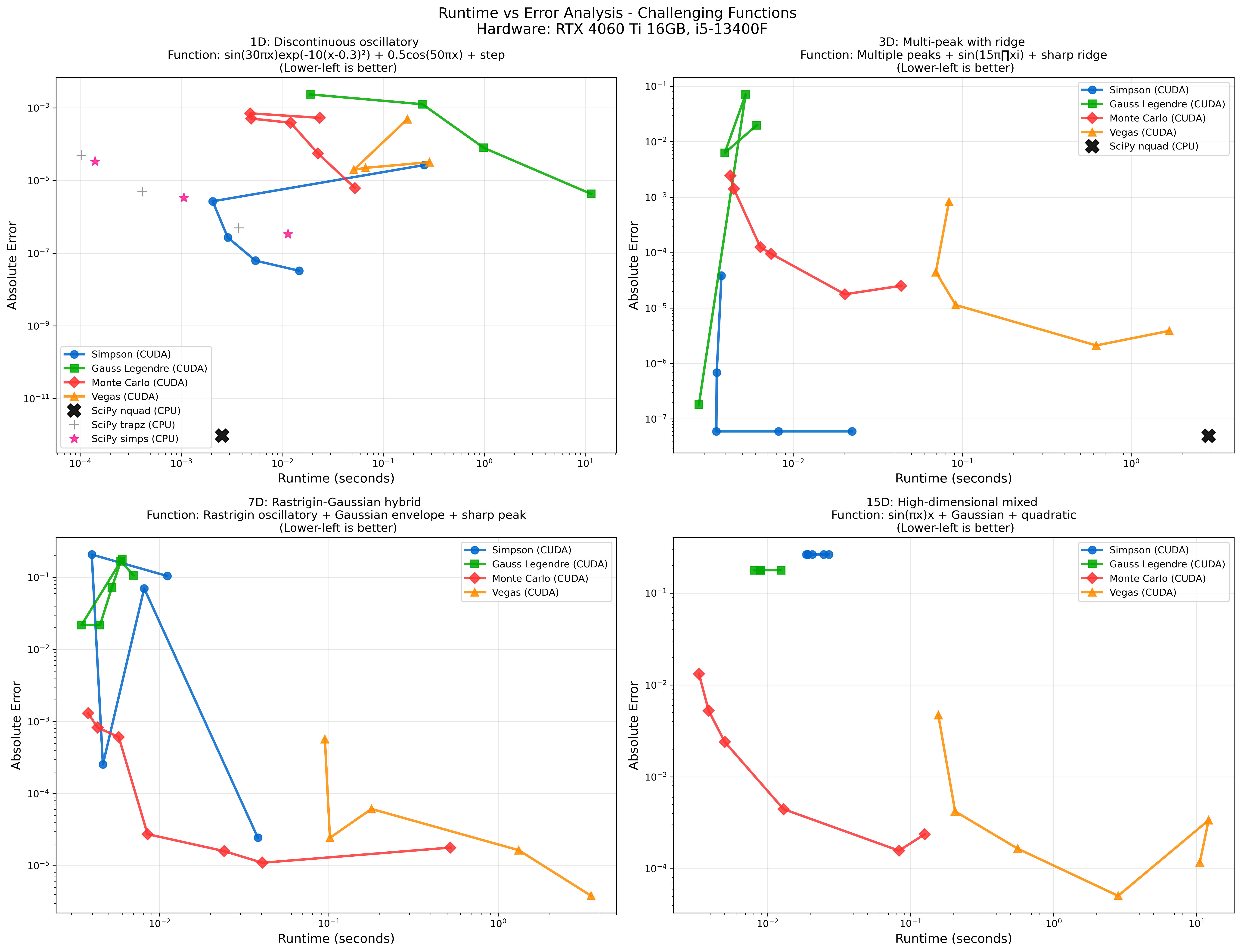 Runtime-error trade-offs across dimensions. Lower-left positions indicate better performance. While scipy's traditional methods are competitive for simple 1D problems, torchquad's GPU acceleration provides orders of magnitude better performance for multi-dimensional integration, achieving both faster computation and lower errors.
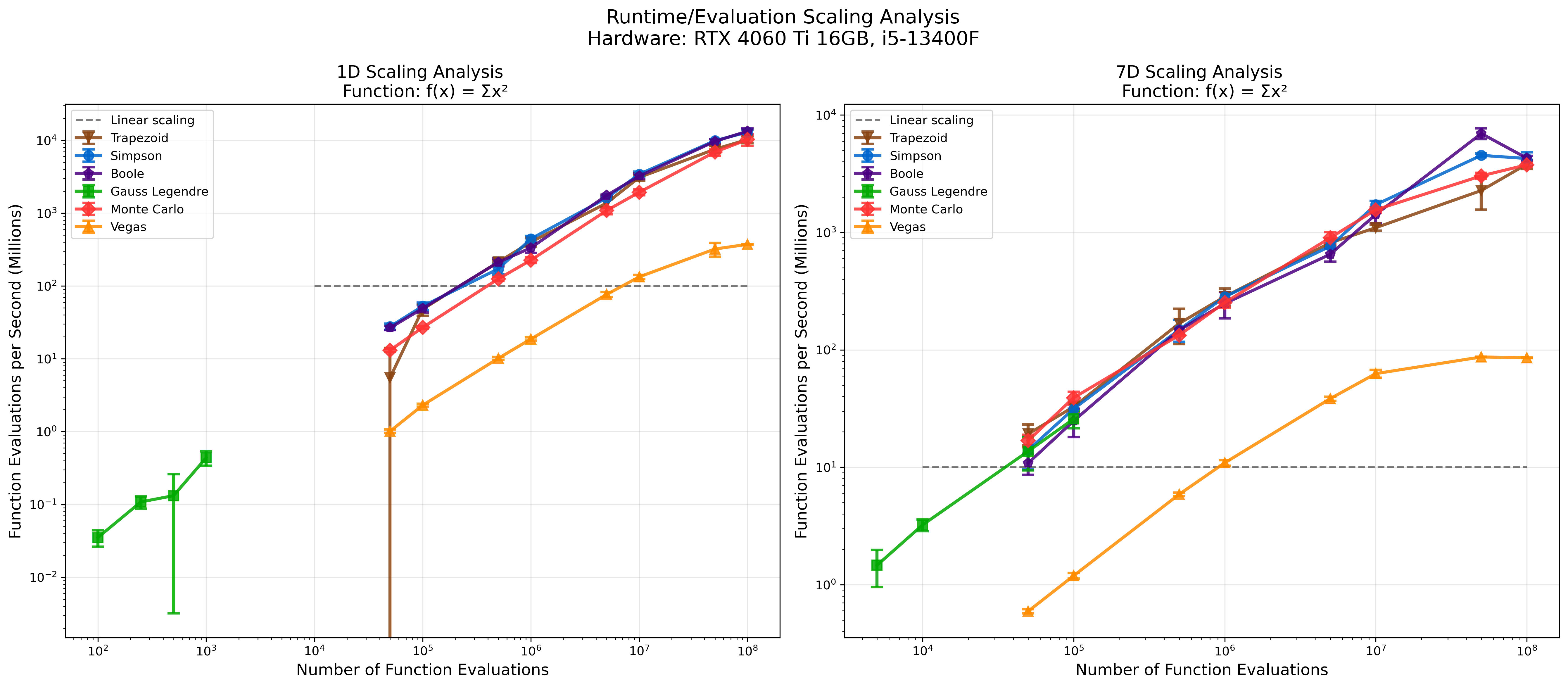 Scaling investigation across problem sizes and dimensions of the different methods in torchquad.
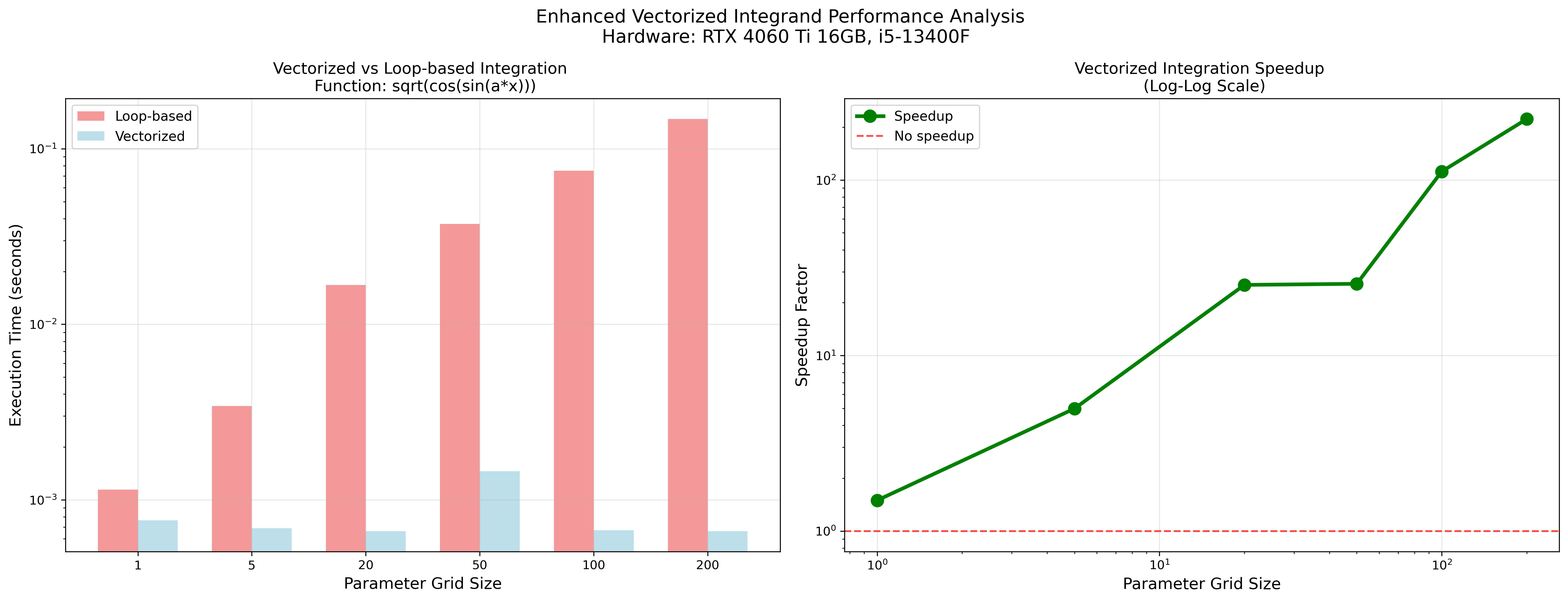 Strong performance gains when evaluating multiple integrands simultaneously. The vectorized approach shows exponential speedup (up to 200x) compared to sequential evaluation, making torchquad ideal for parameter sweeps, uncertainty quantification, and machine learning applications requiring batch integration.
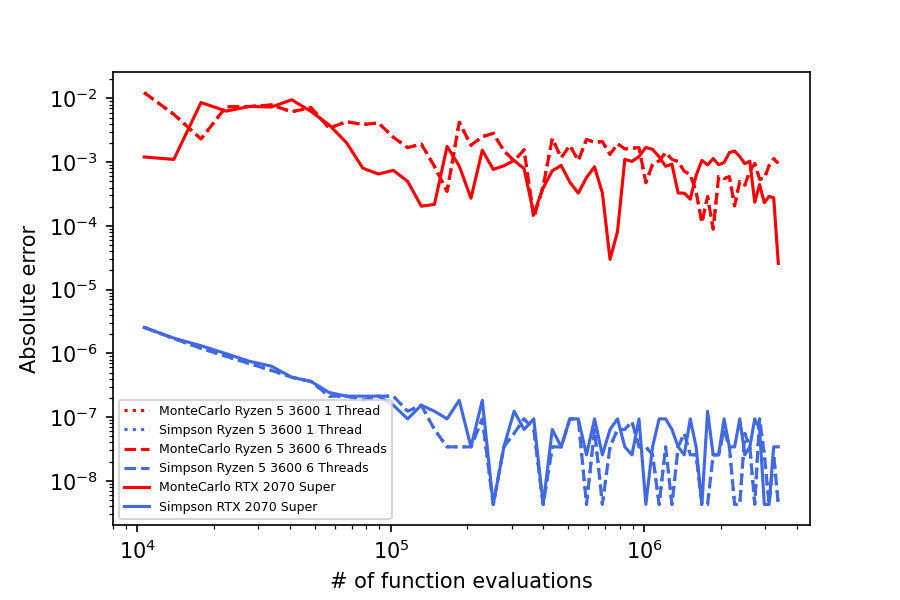
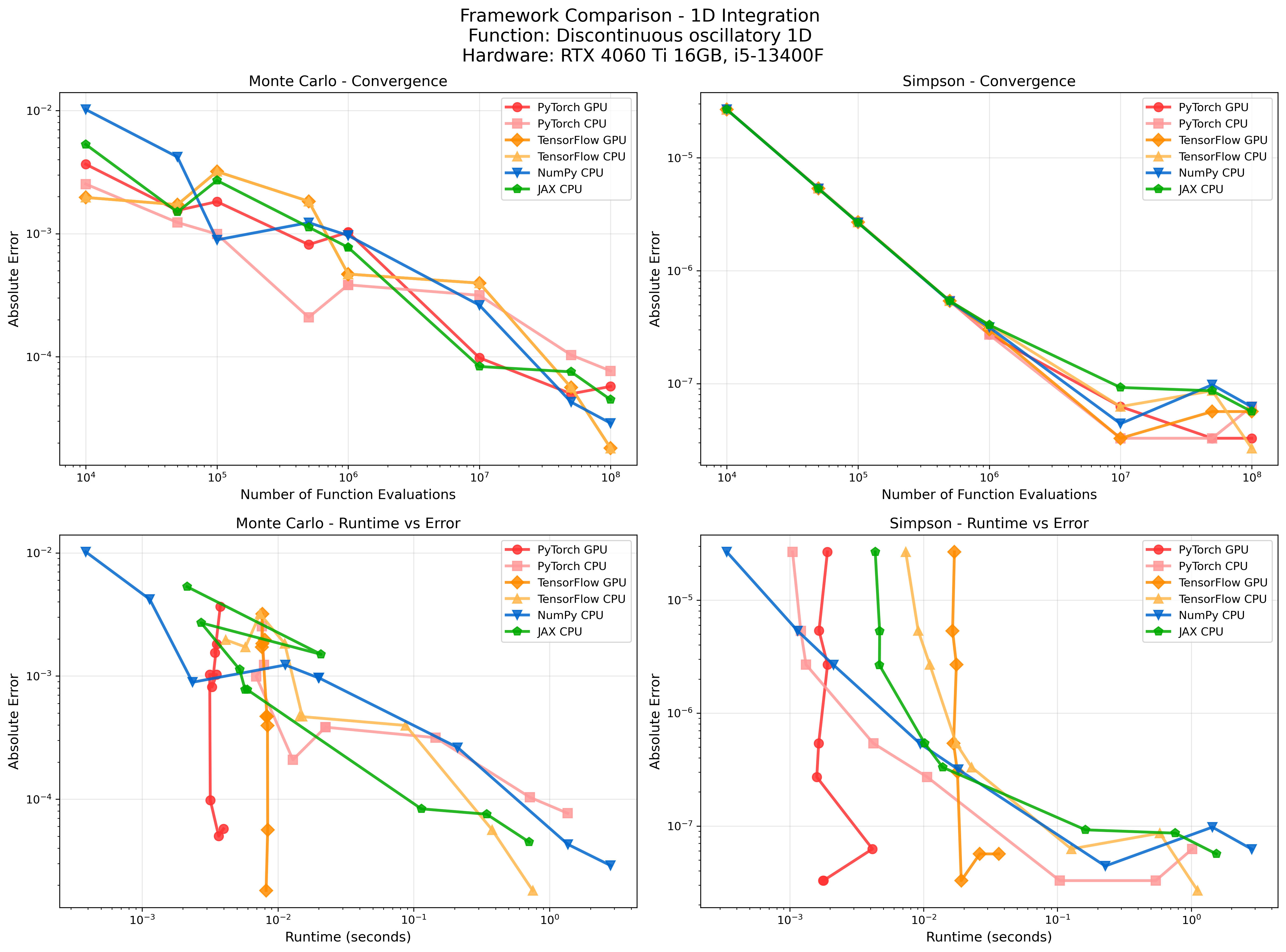 Cross-framework performance comparison for 1D integration using Monte Carlo and Simpson methods. Demonstrates torchquad's consistent API across PyTorch, TensorFlow, JAX, and NumPy backends, with GPU acceleration providing significant performance advantages for large number of function evaluations. All frameworks achieve similar accuracy while showcasing the computational benefits of GPU acceleration for parallel integration methods.
To reproduce these benchmarks or test performance on your hardware:
# Run all benchmarks (convergence, framework comparison, scaling, vectorized)
python benchmarking/modular_benchmark.py --dimensions 1,3,7,15

# Run specific benchmark types
python benchmarking/modular_benchmark.py --convergence-only --dimensions 1,3,7,15
python benchmarking/modular_benchmark.py --scaling-only
python benchmarking/modular_benchmark.py --framework-only

# Generate all plots from results
python benchmarking/plot_results.py

# Configure benchmark parameters
# Edit benchmarking/benchmarking_cfg.toml to adjust:
# - Evaluation point ranges
# - Framework backends to test
# - Timeout limits
# - Method selection
# - scipy integration tolerances
New Features:
Hardware: RTX 4060 Ti 16GB, i5-13400F, Precision: float32
The project is open to community contributions. Feel free to open an issue or write us an email if you would like to discuss a problem or idea first.
If you want to contribute, please
git clone https://github.com/esa/torchquad.git
environment_all_backends.yml.torchquad and installs the required dependencies.conda env create -f environment_all_backends.yml
conda activate torchquad
Once the installation is done, you are ready to contribute.
Please note that PRs should be created from and into the develop branch. For each release the develop branch is merged into main.
git checkout -b feature/AmazingFeature)git commit -m 'Add some AmazingFeature')git push origin feature/AmazingFeature)develop branch, not mainand we will have a look at your contribution as soon as we can.
Furthermore, please make sure that your PR passes all automated tests, you can ping @gomezzz to run the CI. Review will only happen after that.
Only PRs created on the develop branch with all tests passing will be considered. The only exception to this rule is if you want to update the documentation in relation to the current release on conda / pip. In that case you open a PR directly into main.
Distributed under the GPL-3.0 License. See LICENSE for more information.
Error enabling CUDA. cuda.is_available() returned False. CPU will be used. conda, you can install them with conda install cudatoolkit. For more detailed installation instructions, please refer to the PyTorch documentation.Created by ESA's Advanced Concepts Team
pablo.gomez at esa.intgabriele.meoni at esa.intProject Link: https://github.com/esa/torchquad
Package providing numerical integration methods for PyTorch, jax, TensorFlow and numpy. Visit Snyk Advisor to see a full health score report for torchquad, including popularity, security, maintenance & community analysis.
The python package torchquad receives a total of 186 weekly downloads. As such, torchquad popularity was classified as limited. Visit the popularity section on Snyk Advisor to see the full health analysis.
We found indications that torchquad maintenance is sustainable demonstrating some project activity. We saw a total of 0 open source contributors collaborating on the project. See the full package health analysis to learn more about the package maintenance status.
The python package torchquad was scanned for known vulnerabilities and missing license, and no issues were found. Thus the package was deemed as safe to use. See the full health analysis review.

Minimize your risk by selecting secure & well maintained open source packages

Scan your application to find vulnerabilities in your: source code, open source dependencies, containers and configuration files
Easily fix your code by leveraging automatically generated PRs
New vulnerabilities are discovered every day. Get notified if your application is affected
